Ghana’s Vice-President, Professor Naana Jane Opoku-Agyemang, has renewed government’s commitment to expanding opportunities for women-owned businesses, with particular attention to affordable financing, industrial development and access to larger markets.
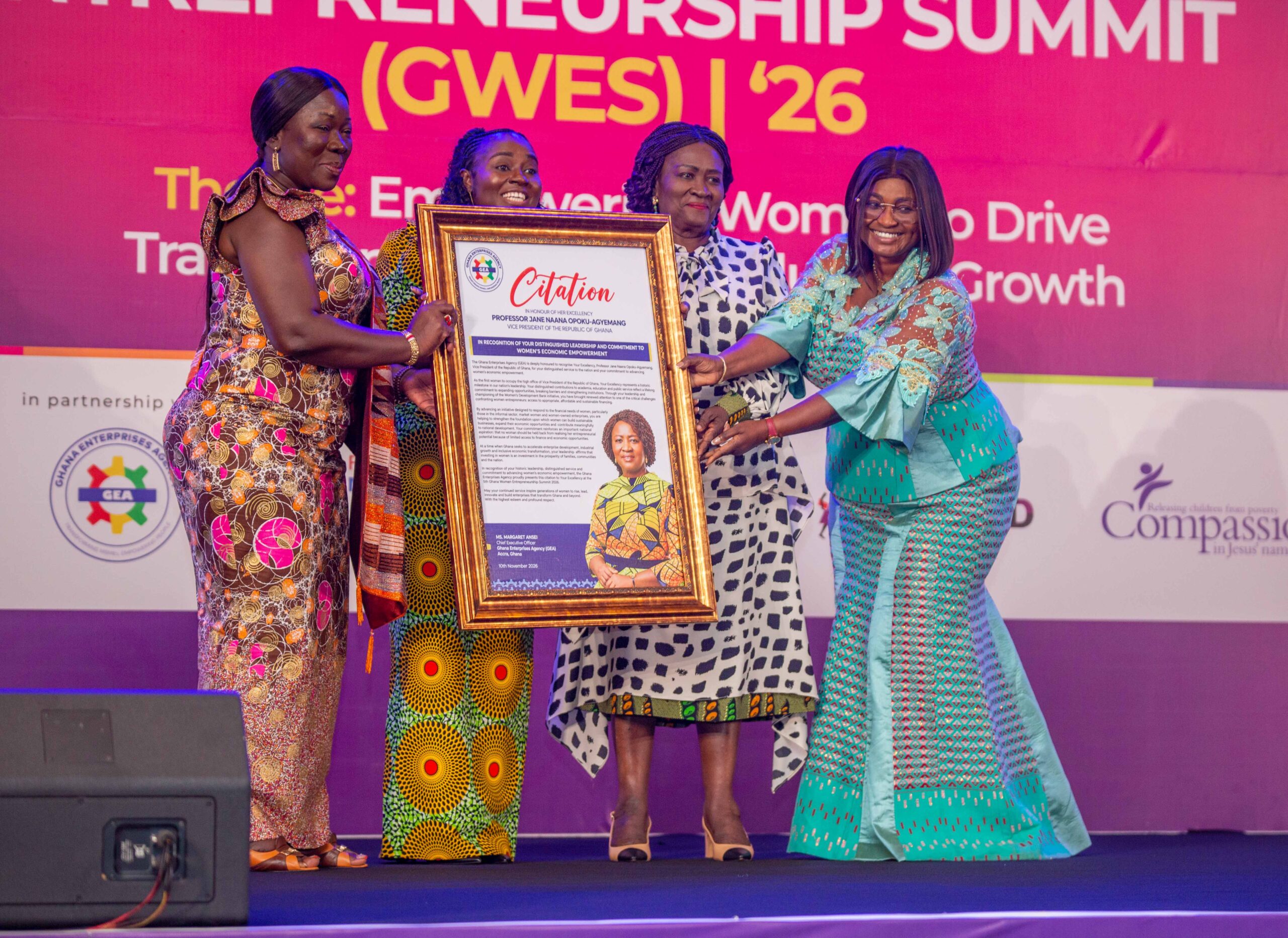
The Vice-President made the commitment at the fifth Ghana Women Entrepreneurship Summit (GWES 2026), held in Accra on Tuesday, 10 November 2026, where she joined the Chief Executive Officer of the Ghana Enterprises Agency (GEA), Margaret Ansei, alongside government officials, financial institutions, development partners and entrepreneurs.
Organised under the theme “Empowering Women to Drive Trade, Innovation and Industrial Growth”, the summit examined practical ways to help women-owned micro, small and medium enterprises (MSMEs) overcome financial and operational difficulties while expanding their contribution to Ghana’s economy.
Professor Opoku-Agyemang said women’s participation in productive sectors must remain central to Ghana’s industrial development plans, particularly as the country seeks to increase local manufacturing, agricultural processing and exports.
She explained that Ghana could achieve greater economic benefits by processing more agricultural produce locally and improving commercial relationships between smaller enterprises and established industries.
Vice-President calls for women-led businesses to expand into manufacturing
Addressing participants, Professor Opoku-Agyemang encouraged women entrepreneurs to look beyond small-scale business activities and pursue opportunities in commercial production, agro-processing, manufacturing and industrial supply chains.
She stressed that women already contribute significantly to economic activity as producers, traders, processors and employers, but many require stronger financial and institutional support to expand their operations.
According to the Vice-President, creating opportunities for women to establish factories, supply larger companies and enter export markets would strengthen local production and contribute to employment.
However, she explained that access to financial resources alone would not guarantee business growth.
Entrepreneurs also need technical knowledge, product certification, improved packaging, safety compliance and the ability to meet the purchasing requirements of supermarkets, manufacturers and international buyers.
These conditions are particularly important for smaller enterprises seeking to move from informal or limited production into organised commercial supply chains.
The Vice-President further identified Ghana’s industrialisation agenda as an opportunity for women-owned enterprises to expand their involvement in processing, storage, distribution and other productive activities.
Women’s Development Bank moves closer to regulatory approval
A major development highlighted at the summit was the proposed establishment of Ghana’s Women’s Development Bank.
Professor Opoku-Agyemang disclosed that an application for a banking licence had been submitted to the Bank of Ghana through the Ministry of Finance.
The application represents a further step towards establishing the proposed financial institution, although the submission does not mean that regulatory approval has already been granted or that the bank has commenced operations.
The planned bank is intended to address financing barriers facing women entrepreneurs, particularly those who struggle to obtain affordable credit through conventional financial institutions.
The Vice-President explained that its development had involved consultations with women from different business backgrounds, including market traders, susu collectors, women’s business associations and financial sector professionals.
Their involvement is intended to ensure that the proposed institution reflects the financial needs and operating circumstances of women-owned enterprises.
The government has previously outlined financial commitments towards the bank, including a GH¢401 million allocation identified in the 2026 national budget.
The proposed intervention is expected to provide a more focused approach to financial inclusion for women entrepreneurs, subject to the necessary regulatory approvals and operational arrangements.
Margaret Ansei highlights working capital challenges facing MSMEs
Speaking at the summit, GEA Chief Executive Officer Margaret Ansei drew attention to a persistent challenge confronting women-led businesses: the difficulty of securing adequate working capital to fulfil substantial orders.
She explained that some entrepreneurs obtain contracts from larger buyers but lack the immediate financial resources required to purchase materials, pay suppliers or increase production.
The problem becomes more complicated when customers operate on extended payment terms while suppliers require immediate settlement.
For smaller businesses, this mismatch can place considerable pressure on cash flow, even when they have confirmed orders.
Ms Ansei called for financial institutions and business support organisations to introduce financing arrangements that better reflect how smaller enterprises operate.
She also emphasised the importance of stronger relationships between government agencies, private businesses and development partners in improving access to markets.
Her remarks highlighted the distinction between obtaining business opportunities and having the financial capacity to deliver them successfully.
Without suitable funding, entrepreneurs may struggle to accept large orders, expand production or establish lasting relationships with corporate customers.
Government outlines export and market support programmes
The Minister for Trade, Agribusiness and Industry, Elizabeth Ofosu-Adjare, also outlined ongoing government interventions aimed at improving the competitiveness of women-owned businesses.
She disclosed that more than 1,300 entrepreneurs had benefited from export training and promotional support delivered through partnerships involving TradeMark Africa and other development partners.
The programmes are intended to help businesses improve their readiness to serve domestic and international markets.
Other initiatives highlighted included product certification, value addition, financing support and opportunities available through the African Continental Free Trade Area (AfCFTA).
For Ghanaian MSMEs, participation in wider markets requires more than identifying potential buyers. Businesses must also meet product standards, maintain consistent supply, manage costs and fulfil commercial obligations.
The summit therefore placed considerable attention on combining access to finance with business training and stronger market connections.
The event also featured the launch of the Youth Enterprise Launchpad, extending discussions on entrepreneurship development to younger business owners.
GWES 2026 reinforces collaboration to support women entrepreneurs
The fifth Ghana Women Entrepreneurship Summit brought together representatives from government, financial institutions, development organisations, industry and the entrepreneurial community.
Participants examined how improved financing, institutional collaboration, business development services and access to markets could help women-owned enterprises grow.
The discussions reflected the broader mandate of the Ghana Enterprises Agency to support MSME development, strengthen business competitiveness and promote employment opportunities.
For women entrepreneurs, the issues raised at GWES 2026 remain closely connected: obtaining affordable finance, building sufficient production capacity and securing buyers capable of supporting long-term business growth.
The proposed Women’s Development Bank is expected to form part of the government’s response to these challenges, although its implementation remains subject to regulatory approval.
Following the summit, attention will turn to how the financing proposals, enterprise support programmes and market access initiatives translate into practical opportunities for women-owned businesses across Ghana.
About the Author