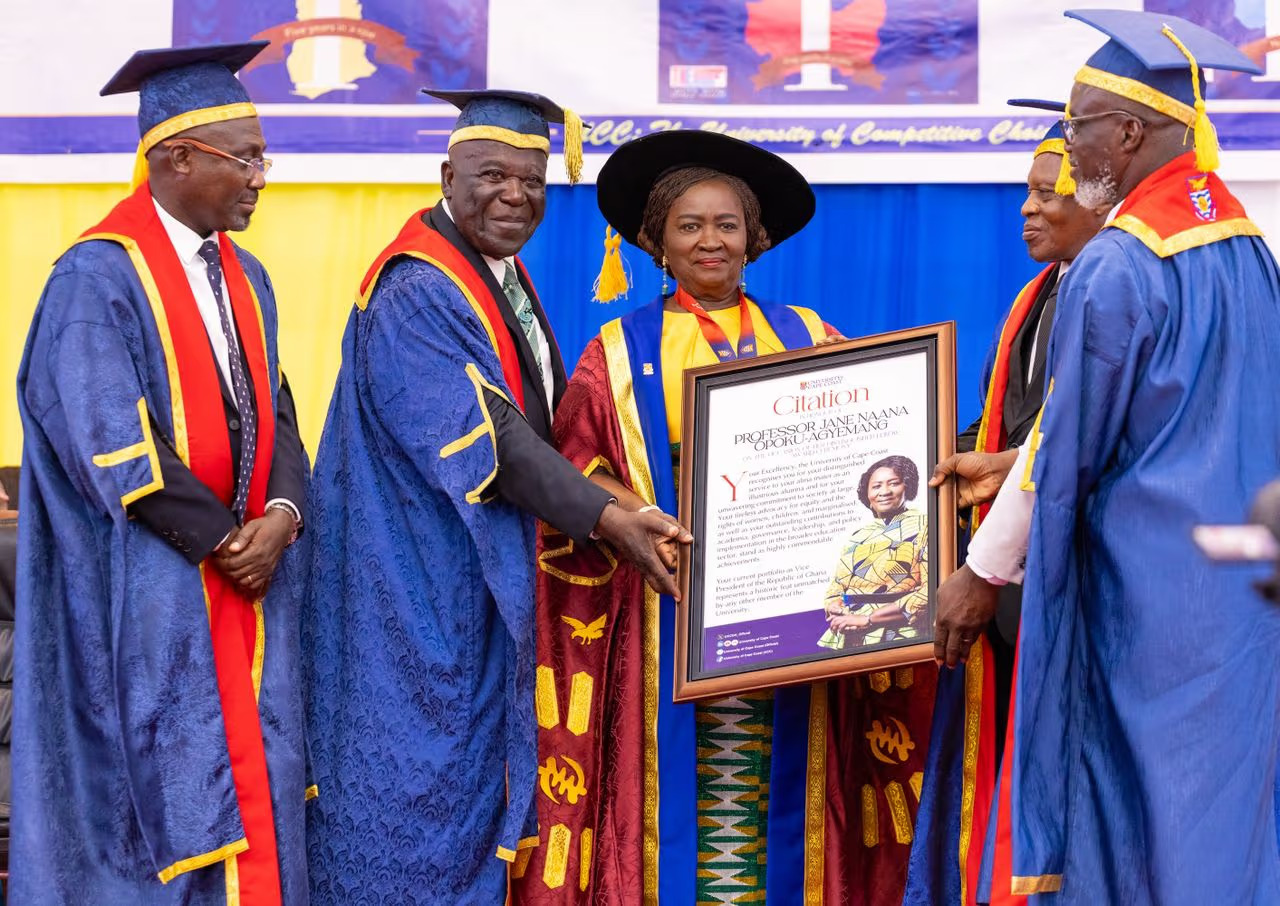
Well-deserved Mahama congratulates Prof Opoku-Agyemang for receiving UCC’s Distinguished Fellow Award after the University of Cape Coast honoured Vice President Professor Jane Naana Opoku-Agyemang for her service to education and her impact on national leadership.
President John Dramani Mahama described the recognition as deserved and shared his message publicly. “Well deserved. Congratulations, Professor Jane Naana Opoku-Agyemang, my Vice President,” he wrote on Facebook as tributes poured in from academics, students and public figures.
UCC honours Vice President at inaugural ceremony
The award was presented on Friday, 13 March 2026, during the University of Cape Coast’s inaugural Distinguished Fellow Award Ceremony. UCC cited Prof Opoku-Agyemang’s contributions to the university, her consistent advocacy for education, and her trailblazing role as a woman in leadership.
The Distinguished Fellow Award is intended to celebrate individuals whose work has advanced the mission of the university and contributed to national development. UCC officials said the honour reflects the Vice President’s longstanding commitment to education as a driver of progress and social mobility.
Prof Opoku-Agyemang reflects on Ghana’s education journey
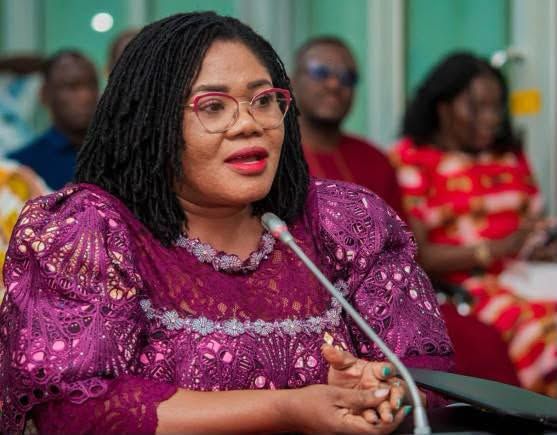
In her acceptance speech, Prof Opoku-Agyemang used the moment to reflect on Ghana’s investment in education since independence. She noted that the steady establishment of tertiary institutions over the decades shows that the country recognises education as a transformative force.
She also referenced the historical roots of the University of Cape Coast, pointing to its founding as a reminder that Ghana has long prioritised training skilled professionals to support national growth. In her words, the university stands as a symbol of the country’s belief that education remains one of the most effective paths to development.
“Higher education must serve society”
A key part of her message was that higher education should not end with personal success or academic titles. Prof Opoku-Agyemang described higher education as a privilege and urged graduates and professionals to ask whether what they learn is improving the society that supported them.
She argued that education must move beyond theory and contribute directly to Ghana’s development goals. That includes building stronger institutions, supporting effective governance, and encouraging innovation that solves real problems.
“Our education challenges us to make tangible improvements in our nation so that we can take pride in our identity and capabilities,” she said. She stressed that the responsibility to give back does not belong only to lecturers and researchers, but to everyone who has benefited from Ghana’s schools and universities.
Why the award matters
For many observers, the award is both personal recognition and a wider statement about national priorities. Prof Opoku-Agyemang has built her career within academia and public service, and her position as Vice President makes her one of the most visible advocates for education and women’s leadership in Ghana today.
UCC’s decision to honour her at the inaugural ceremony also signals a desire to highlight role models who represent public service, academic excellence and national impact. Supporters say her recognition could inspire young women, especially students and early-career professionals, to see leadership as achievable and meaningful.
Mahama’s message and public reaction
President Mahama’s congratulatory message quickly gained traction online, with many Ghanaians describing the award as timely and deserved. Some praised Prof Opoku-Agyemang for staying connected to education even while serving in high office. Others focused on her message about building stronger institutions, noting that national development depends not only on policies but also on a culture of responsibility and service.
The ceremony also reinforced the role universities play in shaping public discourse. Beyond teaching and research, institutions like UCC often serve as platforms where national issues like education quality, governance, values and leadership are discussed with clarity and depth.
The bigger message
At its heart, the event was not just about an award. It was about what education should mean for Ghana. Prof Opoku-Agyemang’s speech pushed a simple question: if higher education is a privilege, how do beneficiaries return value to the country?
Her answer was clear. Education should produce problem solvers, ethical leaders, and citizens who strengthen institutions and improve lives. That message, delivered at a university ceremony and amplified by the President’s public congratulations, is likely to resonate beyond UCC’s campus.
About the Author